
What Are Peptides? A Clear Introduction Before You Buy
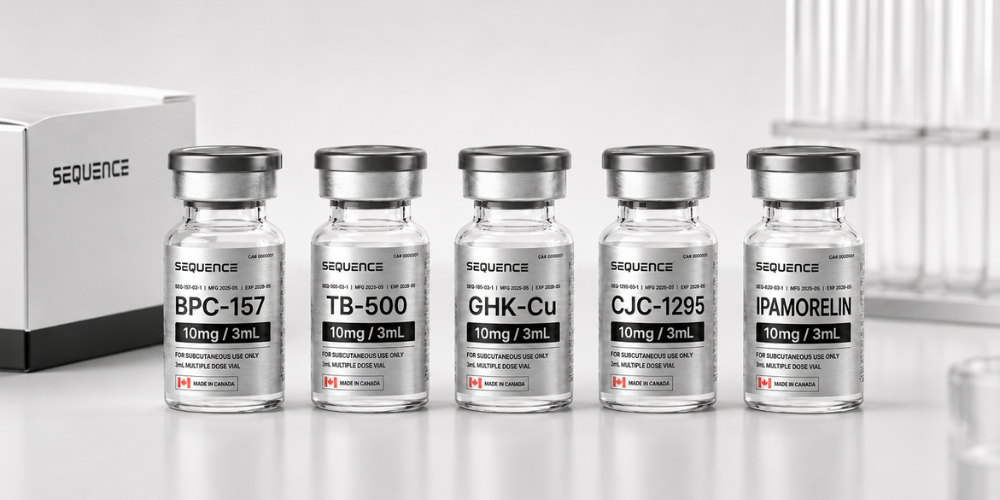
The peptide market has no shortage of confidence.
It has glossy labels, dramatic claims, overnight “experts,” and enough miracle-language to make a sensible person want to lie down in a quiet room.
But before comparing compounds, concentrations, product categories, or vial formats, it helps to start with the basics:
At the simplest level, peptides are short chains of amino acids linked together by peptide bonds. Amino acids are the building blocks. Peptides are short sequences of those building blocks. Proteins are usually larger, more complex structures made from longer amino-acid chains. The distinction is not always perfectly clean in casual language, but the general framework matters.
SEQUENCE exists in a market where product clarity matters. If a customer is going to compare compounds, read labels, evaluate concentrations, or understand testing, they should first understand the basic language.
No fog machine.
No miracle costume.
Just the starting point.
What Is a Peptide?
A peptide is a chain of amino acids connected by chemical bonds known as peptide bonds.
Amino acids can be thought of as individual units. When those units connect in a sequence, they form peptides or proteins depending on length, structure, and function.
A simple way to frame it:
| Term | Simple Meaning |
|---|---|
| Amino acid | A single building block |
| Peptide | A shorter chain of amino acids |
| Protein | A larger, more complex amino-acid chain or structure |
In biological systems, peptides can be involved in signaling, communication, structure, regulation, and many other processes. Some peptides occur naturally in the body. Others are synthesized for research, pharmaceutical development, cosmetic use, or other specialized applications.
The important point is this:
Peptides are not magic. They are structured molecular sequences.
That structure is exactly why naming, concentration, handling, and testing matter.
Peptides vs Proteins: What’s the Difference?
Peptides and proteins are both made from amino acids, but they are usually discussed differently because of their size and complexity.
A peptide is generally shorter. A protein is usually larger and more structurally complex. Proteins may fold into specific three-dimensional shapes that influence how they behave in biological systems. Some scientific and regulatory contexts use specific amino-acid length cutoffs, while broader educational explanations often describe peptides as shorter chains and proteins as longer, more complex structures.
For a customer reading a SEQUENCE product page, this distinction helps explain why peptide products are typically presented as specific compounds with defined names and measured amounts.
A vial is not just “a peptide.”
It should tell you:
- which peptide compound it contains
- how much compound is present
- what the vial format is
- what batch it belongs to
- whether testing or verification is available
The label should not feel like a riddle written during a power outage.
Why Are Peptides Discussed in Research?
Peptides are widely discussed in research because different peptide sequences may interact with different biological pathways.
Depending on the compound, peptide research may involve topics such as:
- tissue repair
- metabolic signaling
- skin and collagen pathways
- neurological signaling
- hormonal signaling
- mitochondrial function
- immune and inflammatory pathways
- cellular aging and longevity research
That does not mean every peptide product has proven human outcomes. This is where the market often gets sloppy.
There is a major difference between:
“This compound is discussed in relation to a research pathway.”
and:
“This product treats, cures, repairs, reverses, or guarantees an outcome.”
SEQUENCE should live firmly in the first category: clear education, defined product information, and no inflated claims.
Some peptide-based products are developed as regulated drugs, and the FDA has specific guidance around clinical pharmacology considerations for peptide drug products. That regulatory context is very different from broad online peptide marketing, which is exactly why careful language and transparent product standards matter.
Common Peptide Categories
Peptides are often grouped by the type of research conversation they belong to.
On a product catalogue, these categories help customers navigate without needing to memorize every compound first.
For SEQUENCE, categories may include:
| Category | General Research Interest |
|---|---|
| Recovery & Repair | Tissue stress, repair models, mobility, remodeling |
| Cognitive & Neurological | Focus, stress signaling, neurological research |
| Metabolic Support | Glucose, appetite, body composition, metabolic pathways |
| Longevity & Cellular Health | Mitochondria, cellular aging, repair signaling |
| Aesthetics & Skin Health | Collagen, skin structure, copper peptides |
| Vitality & Hormonal Support | Hormonal signaling, reproductive pathways, vitality research |
| Performance & Body Composition | Lean mass, recovery load, adaptation, performance contexts |
These categories are not medical promises. They are organizational tools.
A clean category system helps customers understand why certain compounds are grouped together and how to compare them more intelligently.
What Does Lyophilized Powder Mean?
Many peptide products are supplied as lyophilized powder.
Lyophilization is another term for freeze-drying. In pharmaceutical and laboratory contexts, freeze-drying is used to remove water under low-temperature and low-pressure conditions, helping improve stability for sensitive materials.
For customers, this usually means the product appears as a dry powder or puck inside the vial before reconstitution.
This matters because storage and handling change depending on whether a peptide is:
- still lyophilized
- already reconstituted
- exposed to heat
- exposed to moisture
- repeatedly warmed and cooled
A product’s quality does not end when it leaves the supplier. Handling matters.
That is why SEQUENCE should give customers clear storage and preparation guidance instead of assuming everyone already speaks fluent vial.
What Does “mg / 3mL” Mean?
A clear peptide product label should make the format obvious.
For example:
BPC-157 | 10mg / 3mL
This tells the customer:
- the compound is BPC-157
- the vial contains 10mg total
- the product is presented in a 3mL vial format
For a combination product, the format may look like this:
BPC-157 & TB-500 | 5mg + 5mg / 3mL
This tells the customer:
- the vial contains BPC-157
- the vial contains TB-500
- each compound is present at 5mg
- the product is presented in a 3mL vial format
That level of clarity matters.
Because vague concentration formatting creates confusion. Confusion creates mistakes. Mistakes create risk. And risk is not a brand personality.
Why Testing and Verification Matter
In the peptide market, claims are easy.
Verification is harder.
A product page can say “high purity.” A label can look premium. A supplier can use scientific language. None of that automatically confirms what is inside the vial.
Testing and verification help connect product claims to measurable data.
A proper verification system may include:
- third-party lab testing
- purity reporting
- batch numbers
- certificates of analysis
- compound identification
- testing method visibility
- sample and batch traceability
Purity reports and testing methods do not answer every possible question, but they are an important part of accountability. They give customers something more concrete than branding and confidence.
In a market full of theatrical certainty, receipts matter.
What a Peptide Product Page Should Make Clear
Before buying any peptide product, customers should be able to answer a few basic questions from the product page.
1. What compound is this?
The product name should be clear and direct.
Example:
Semax | 10mg / 3mL
GHK-Cu | 50mg / 3mL
BPC-157 & TB-500 | 5mg + 5mg / 3mL
No mystery. No abbreviation soup without explanation.
2. How much compound is in the vial?
The total amount should be clearly listed.
For single-compound products, this may be simple:
10mg / 3mL
For combination products, each compound should be listed separately:
5mg + 5mg / 3mL
This is where sloppy labeling can become a problem. Combination products especially need clean formatting.
3. What category does it belong to?
A customer should understand whether the compound is generally grouped under:
- recovery and repair
- metabolic support
- cognitive and neurological research
- longevity and cellular health
- skin and aesthetics
- vitality and hormonal support
Categories help orient the customer before they go deeper.
4. Is testing available?
A strong product page should direct customers toward batch testing or a verification page.
Even when a new product batch is awaiting results, the testing standard should be visible. Customers should know what the company intends to verify and how results will be displayed.
5. How should it be stored?
Storage guidance should be easy to find.
At minimum, customers should understand the difference between storing a lyophilized vial and storing a reconstituted vial.
This does not need to be buried in a support email like a cursed treasure map.
How SEQUENCE Approaches Peptide Education
SEQUENCE is not trying to make peptide education louder.
It should make it cleaner.
The goal is to help customers understand:
- what they are looking at
- how compounds are named
- how concentrations are formatted
- how categories are organized
- why testing matters
- why handling matters
- why product clarity should come before marketing hype
The peptide market already has enough oversized claims.
SEQUENCE’s job is to build a sharper standard around information, presentation, and verification.
Understand the Vial Before You Compare the Vial
Peptides are short chains of amino acids with specific structures and research relevance.
But a peptide product is more than a name on a vial.
A proper product should be understandable. It should clearly show the compound, format, concentration, batch identity, and testing status. It should be supported by practical storage information and honest educational context.
That is the baseline.
Not luxury.
Not bonus.
Not “above and beyond.”
The baseline.
Because before someone compares BPC-157 to TB-500, Semax to Selank, or GHK-Cu to KLOW, they should first understand how to read the product in front of them.
That is where better decisions start.
Start With the SEQUENCE Catalogue
Now that the basics are clearer, explore the SEQUENCE catalogue by category. Compare compounds by research interest, vial format, concentration, and product structure – without the fog machine.