
Tissue Repair Pathways: Why BPC-157, TB-500, KPV, and GHK-Cu Are Often Grouped Together
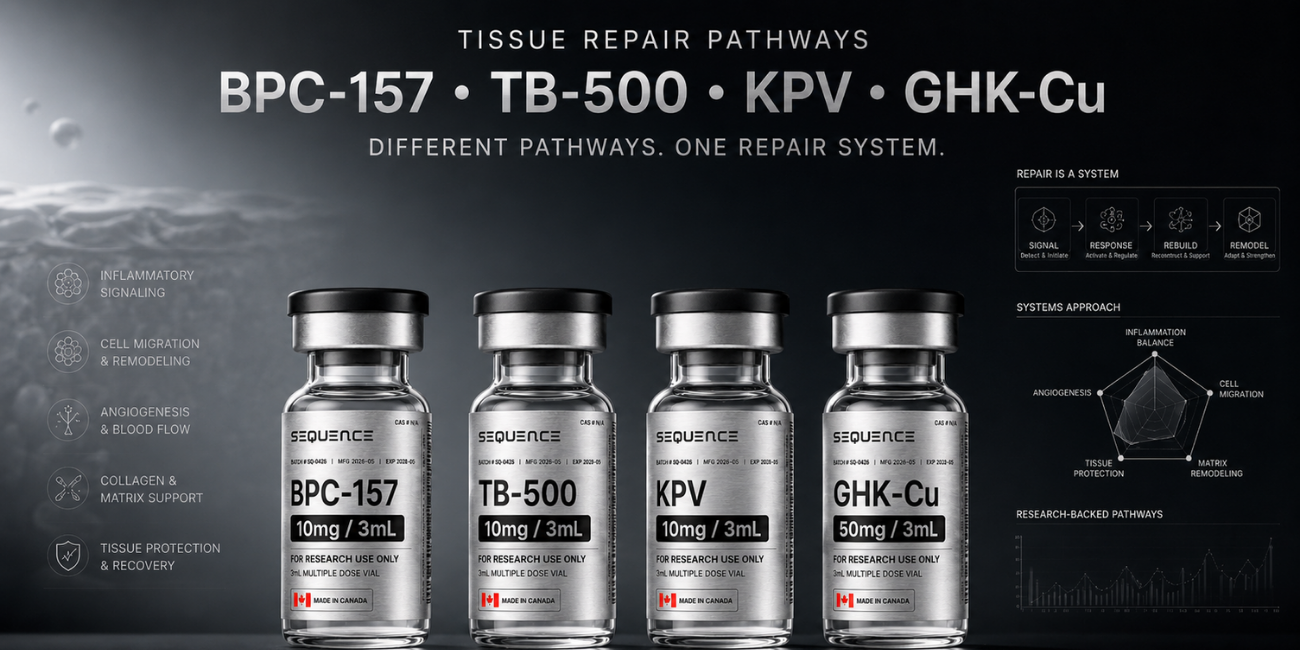
Recovery is often spoken about like a single event.
Something gets stressed, damaged, inflamed, strained, irritated, or overworked – and then the body “repairs it.”
Clean story.
Convenient story.
Incomplete story.
Tissue repair is not one pathway. It is a coordinated process involving inflammatory signaling, vascular response, cellular migration, extracellular matrix remodeling, collagen organization, oxidative stress response, immune regulation, and structural rebuilding.
That is why certain peptides are often discussed together.
Not because they are identical.
Not because more compounds automatically means a smarter product.
Not because a blend name can magically compress biology into a slogan.
BPC-157, TB-500, KPV, and GHK-Cu are commonly grouped because they each sit near different parts of the broader repair conversation:
| Compound | Common Research Context |
|---|---|
| BPC-157 | Tissue repair models, angiogenesis, tendon/ligament research, gastrointestinal protection |
| TB-500 / Thymosin β4 pathway | Cell migration, actin regulation, wound repair, tissue remodeling |
| KPV | Inflammatory signaling, epithelial barrier research, gut/skin immune response |
| GHK-Cu | Copper peptide signaling, collagen, skin remodeling, wound healing, extracellular matrix |
This guide explains the category logic behind that grouping – sharply, clinically, and without pretending that pathway research is the same as a guaranteed outcome.
Because repair biology deserves better than “Wolverine stack” language.
That phrase should be escorted out of the building.
Recovery Is Not One Pathway
Tissue repair is a system.
Depending on the tissue type and the kind of stress involved, repair can include:
- inflammatory signaling
- immune-cell recruitment
- angiogenesis and blood-flow response
- fibroblast activity
- collagen production and organization
- extracellular matrix remodeling
- epithelial barrier repair
- cell migration
- oxidative stress response
- scar formation or remodeling
- tissue-specific regeneration limits
The key point is simple:
Repair is not one switch. It is a sequence of signals.
That is why compounds discussed in tissue repair research often appear in clusters. One compound may be discussed around vascular response. Another around cell migration. Another around inflammatory signaling. Another around collagen or skin remodeling.
A responsible product category does not flatten all of that into “healing.”
It explains the map.
BPC-157: The Local Repair and Vascular Response Conversation
BPC-157 is commonly discussed in relation to localized repair models, tendon and ligament research, gastrointestinal tissue protection, and vascular response.
A 2025 narrative review describes BPC-157 as being studied across several preclinical models involving tendon, ligament, muscle, nerve, gastrointestinal, and vascular injury pathways. The same review notes that much of the current evidence remains preclinical, with limited human data – which is an important distinction for responsible product language.
In tissue repair conversations, BPC-157 is often grouped around several research themes:
- tendon and ligament models
- soft-tissue stress research
- angiogenesis and vascular response
- gastrointestinal protection pathways
- inflammatory and oxidative stress signaling
- tissue resilience under injury models
The appeal of BPC-157 in this category is not that it “repairs everything.”
The responsible framing is more precise:
BPC-157 is commonly discussed in preclinical tissue repair research, especially around soft-tissue, vascular, and gastrointestinal models.
That difference matters.
TB-500: The Cell Migration and Remodeling Conversation
TB-500 is commonly marketed in relation to the thymosin beta-4 pathway.
This is where precision matters. TB-500 is often discussed alongside thymosin beta-4, but broad thymosin beta-4 literature should not always be treated as direct proof for every TB-500 product claim.
Still, the reason this compound appears in repair conversations is clear: thymosin beta-4 has been studied in relation to cell migration, wound healing, angiogenesis, actin regulation, tissue protection, and tissue remodeling. A 2021 review on thymosin β4 describes research interest in wound healing, angiogenesis, inflammatory regulation, and tissue repair-related mechanisms.
Common research themes include:
- cell migration
- actin-related repair pathways
- wound closure models
- angiogenesis
- tissue remodeling
- structural repair signaling
If BPC-157 is often framed around localized repair and vascular response, TB-500 is often framed around movement and remodeling – cells moving, tissue reorganizing, structure being rebuilt.
Again, the responsible wording is not:
“TB-500 heals injuries.”
The responsible wording is:
TB-500 is commonly discussed in relation to thymosin beta-4-associated pathways involving cell migration, wound repair, and tissue remodeling research.
Less exciting.
More accurate.
That is usually the trade.
KPV: The Inflammatory Signaling and Barrier Conversation
KPV is a short tripeptide sequence: lysine-proline-valine.
It is commonly discussed in relation to inflammatory signaling, epithelial barrier research, gut health models, skin-related immune response, and tissue irritation pathways.
Research has examined KPV in inflammatory bowel disease models, including work showing that KPV uptake through the PepT1 transporter reduced intestinal inflammation in experimental settings. Another study explored hyaluronic-acid nanoparticle delivery of KPV in ulcerative colitis models, reporting effects related to mucosal healing and inflammatory reduction in that experimental context.
In the tissue repair category, KPV is usually not positioned as a structural remodeling compound in the same way as GHK-Cu or thymosin beta-4.
Its role in the grouping is different.
KPV is more often discussed around:
- inflammatory signaling
- epithelial barrier research
- gut and skin tissue models
- immune-response modulation
- irritation and mucosal repair contexts
This matters because tissue repair does not happen in a vacuum. Inflammatory signaling shapes the repair environment.
Too little inflammatory response can impair defense and cleanup.
Too much prolonged inflammatory signaling can interfere with repair quality.
KPV’s relevance in this grouping comes from that inflammatory and barrier-focused conversation.
It is not the hammer.
It is more like the environment control system.
GHK-Cu: The Copper Peptide and Remodeling Conversation
GHK-Cu is a copper-binding peptide often discussed in skin health, wound healing, collagen support, extracellular matrix remodeling, and tissue regeneration research.
A 2018 review describes GHK-Cu as having protective and regenerative actions in human skin, including research interest around wound healing, tissue repair, anti-inflammatory effects, and gene-expression changes associated with remodeling pathways. A separate review discusses GHK as a copper complex involved in wound healing and skin repair, connecting it to collagen, extracellular matrix, and tissue remodeling research.
GHK-Cu is often discussed in relation to:
- collagen production
- elastin and skin structure
- wound healing models
- extracellular matrix remodeling
- copper peptide signaling
- antioxidant and anti-inflammatory pathways
- skin integrity and tissue regeneration
In a repair-focused grouping, GHK-Cu often sits at the structural remodeling end of the conversation.
It is not just about “skin aesthetics.”
That is the shallow version.
The more precise framing is:
GHK-Cu is commonly discussed in skin and tissue remodeling research because copper peptide signaling intersects with collagen, extracellular matrix, wound healing, and regenerative pathways.
That is why it can appear in both Aesthetics & Skin Health and Recovery & Repair categories.
Different front door. Same building.
Why These Compounds Are Often Grouped Together
BPC-157, TB-500, KPV, and GHK-Cu are often grouped together because tissue repair involves multiple systems.
A clean way to organize the logic:
| Repair Component | Commonly Associated Compound |
|---|---|
| Localized repair / vascular response | BPC-157 |
| Cell migration / tissue remodeling | TB-500 / thymosin β4 pathway |
| Inflammatory and barrier signaling | KPV |
| Collagen / skin / extracellular matrix remodeling | GHK-Cu |
This does not mean each compound has the same evidence level.
It does not mean they should be treated as interchangeable.
It does not mean a combination formula automatically becomes superior.
It means they are often discussed around different pieces of the same repair ecosystem.
That is the category logic.
Tissue Repair Is a Sequence, Not a Slogan
The name SEQUENCE fits this category almost too well.
Tissue repair itself is sequential.
A simplified version looks like this:
1. Signal
The body detects tissue stress, disruption, irritation, or injury.
Inflammatory mediators, immune signals, local chemical changes, and mechanical stress signals begin shaping the repair environment.
2. Respond
Cells move into the area. Blood flow and vascular response may change. Immune activity participates in cleanup, defense, and signaling.
This is where inflammatory balance matters.
3. Rebuild
Fibroblasts, collagen, extracellular matrix components, and structural proteins become more relevant as tissue integrity is restored or remodeled.
4. Remodel
The tissue reorganizes over time.
This stage is not just “repair completed.” It can involve scar formation, remodeling, adaptation, and changes in tissue quality depending on context.
That is why a serious repair category should not be built around one-word claims.
It should be built around pathway literacy.
Where KLOW Fits Into the Conversation
KLOW is a broader multi-compound format that brings together four compounds commonly discussed across tissue repair, inflammatory signaling, skin integrity, and remodeling research.
KLOW | 80mg / 3mL
10mg BPC-157 + 10mg TB-500 + 10mg KPV + 50mg GHK-Cu
The category logic is straightforward:
| Compound | Role in the Research Conversation |
|---|---|
| BPC-157 | Localized repair, vascular response, gastrointestinal/tissue models |
| TB-500 | Cell migration, actin-related pathways, tissue remodeling |
| KPV | Inflammatory signaling, epithelial barrier research |
| GHK-Cu | Copper peptide signaling, collagen, skin/tissue remodeling |
A formula like this requires especially clear labeling.
If a product includes multiple compounds, the customer should not have to guess what each contributes. The product page should show the breakdown clearly.
A vague label like:
Advanced Repair Blend | 80mg
is not good enough.
A clearer format is:
KLOW | 80mg / 3mL
10mg BPC-157 + 10mg TB-500 + 10mg KPV + 50mg GHK-Cu
That is the difference between a product structure and a marketing fog bank.
What This Grouping Does Not Mean
This grouping should not be interpreted as a medical claim.
It does not mean these compounds:
- treat injuries
- cure pain
- repair damaged tissue in humans
- replace medical care
- guarantee recovery
- resolve inflammation
- improve performance outcomes
- produce predictable results across individuals
Pathway relevance is not the same as clinical certainty.
Preclinical data is not the same as approved therapeutic use.
A product category is not a treatment plan.
SEQUENCE should be especially disciplined here because tissue repair language can get reckless quickly. “Repair” is a useful research category. It is also a word that can drift into implied medical claims if handled poorly.
The clean framing is:
These compounds are commonly discussed together because they intersect with different tissue repair-related pathways in research contexts.
That is the line.
How SEQUENCE Frames Research Pathways
The Research Pathways category exists to explain systems.
Not hype.
Not protocols disguised as education.
Not compound fan fiction.
This section of the SEQUENCE journal should help customers understand why certain compounds are discussed in relation to specific biological categories.
For tissue repair, that means explaining:
- inflammatory signaling
- vascular response
- cell migration
- collagen and extracellular matrix remodeling
- epithelial barrier integrity
- wound-healing models
- skin and connective-tissue research
From there, individual compound guides and product pages can explain where specific products fit.
The pathway comes first.
The product follows.
That order matters.