
Single Peptides vs Combination Vials: How to Think About Product Pairings
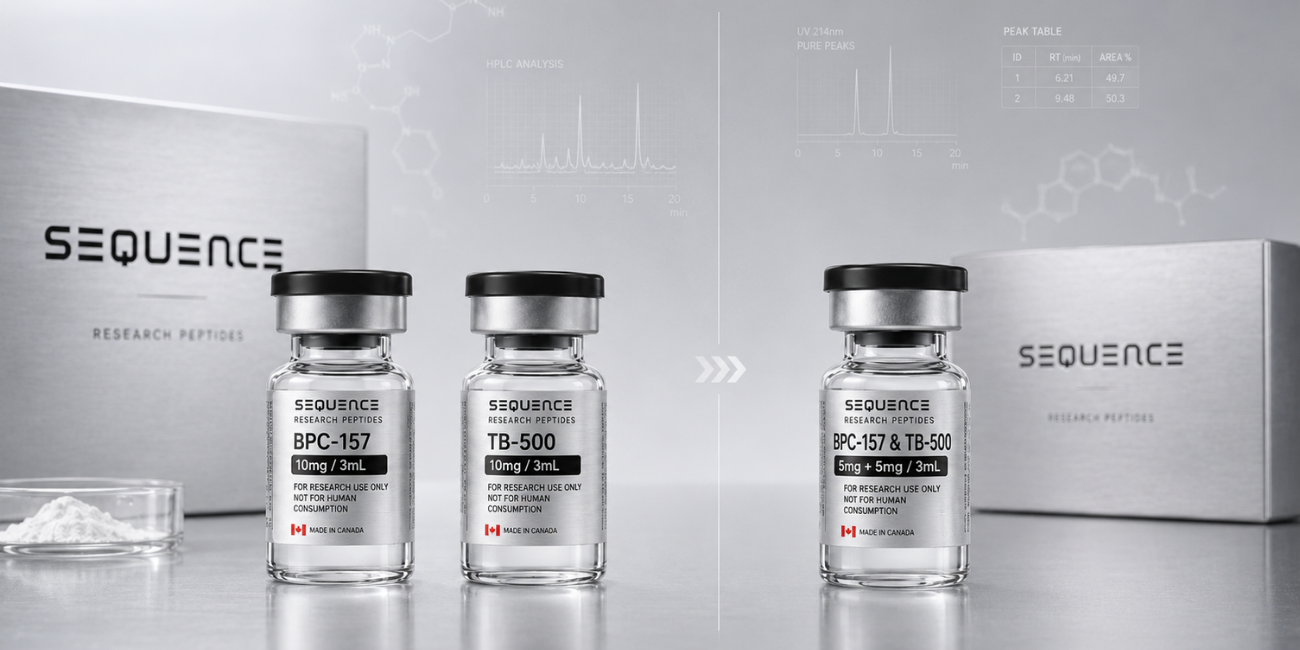
In the peptide market, the word “stack” gets thrown around far too easily.
Sometimes a pairing makes sense. Sometimes two compounds belong in the same broader research conversation. Sometimes a combination vial gives customers a cleaner way to compare related products.
And sometimes?
Sometimes it is just marketing duct tape wrapped around a vague idea.
At SEQUENCE, product pairings are not treated like mystery protocols or miracle formulas. They are treated as structured formats: clear compound names, defined concentrations, category logic, batch traceability, and no label mathematics that require a candlelit decoding ceremony.
This guide explains the difference between single-compound peptides and combination vials, why certain compounds are often paired, and how customers can compare product formats with more clarity.
Not Every Pairing Is a Protocol
A product pairing is not automatically a protocol.
That distinction matters.
A product pairing means two or more compounds are presented together because they are commonly discussed within a related category, pathway, or research context.
A protocol, on the other hand, implies a more specific decision-making framework – timing, sequence, purpose, schedule, and use-case logic.
SEQUENCE uses the phrase Protocols & Product Pairings carefully because the goal is not to turn every combination vial into an instruction manual.
The cleaner framing is this:
A pairing helps organize related compounds. A protocol requires deeper context.
This category exists to help customers compare products, understand why certain compounds are grouped together, and recognize when single-compound formats may offer more focused selection.
No hype stack.
No fog machine.
No “trust me bro” chemistry buffet.
Just better structure.
What Is a Single-Compound Peptide?
A single-compound peptide contains one listed peptide compound in a defined amount and vial format.
Examples may include:
- BPC-157 | 10mg / 3mL
- TB-500 | 10mg / 3mL
- Semax | 10mg / 3mL
- Selank | 10mg / 3mL
- GHK-Cu | 50mg / 3mL
- MOTS-c | 10mg / 3mL
Single-compound products are useful because they keep the comparison clean.
The customer can focus on one compound, one label, one concentration, and one product category at a time.
That simplicity matters.
A clean single-compound vial should make the following obvious:
| Label Detail | What It Tells You |
|---|---|
| Compound name | Which peptide is present |
| Total amount | How much compound is in the vial |
| Vial format | The presentation format, such as 3mL |
| Batch number | Which batch the vial belongs to |
| Testing status | Whether verification is available or pending |
| Storage guidance | How the product should be handled |
A single-compound product is often the cleanest format for focused comparison.
No blend name.
No hidden formula.
No “advanced matrix” nonsense scribbled onto a label like it escaped from a supplement conference booth.
What Is a Combination Vial?
A combination vial contains two or more compounds in one product format.
Examples may include:
- BPC-157 & TB-500 | 5mg + 5mg / 3mL
- Semax & Selank | 6mg + 6mg / 3mL
- KLOW | 80mg / 3mL
Combination vials are usually built around compounds that are commonly discussed together within a similar or complementary research category.
For example:
| Combination | Common Research Category |
|---|---|
| BPC-157 & TB-500 | Recovery, repair, mobility, tissue-remodeling research |
| Semax & Selank | Cognitive, neurological, and stress-signaling research |
| KLOW | Broader recovery, repair, inflammatory, and skin/tissue-remodeling research |
Combination vials can make comparison easier when the pairing itself is already well-recognized.
But they also require more discipline.
A combination vial should clearly show:
- every compound included
- how much of each compound is present
- the total vial format
- batch identity
- storage guidance
- testing and verification status
This is where many products in the market get sloppy.
A label that says:
Recovery Blend | 10mg
does not provide enough information.
A clearer format is:
BPC-157 & TB-500 | 5mg + 5mg / 3mL
That tells the customer exactly what is inside and how the combination is structured.
That is not a luxury detail.
That is the baseline.
Why Are Certain Peptides Commonly Paired?
Certain peptides are commonly paired because they sit near each other in the same broader research conversation.
That does not mean they are identical.
It does not mean they do the same thing.
It does not mean more compounds automatically equals a better product.
It simply means the compounds are often discussed under overlapping categories.
A clean way to think about pairing logic:
| Pairing | Why They Are Often Discussed Together |
|---|---|
| BPC-157 + TB-500 | Both are commonly discussed in recovery, repair, soft tissue, mobility, and tissue-remodeling contexts |
| Semax + Selank | Both are commonly discussed in cognitive, neurological, stress-response, and focus-related research contexts |
| BPC-157 + TB-500 + KPV + GHK-Cu | These compounds are often grouped around recovery, inflammatory signaling, tissue integrity, and skin/connective-tissue research |
A pairing should make category sense before it makes marketing sense.
That is the whole point.
If the only explanation behind a combination product is “because more sounds better,” the product is not more advanced. It is just crowded.
More ingredients do not automatically mean more intelligence. Sometimes it just means the label got busy and nobody wanted to admit the idea needed editing.
Single Peptides vs Combination Vials: Which Is Easier to Compare?
Both formats have a place.
The question is not which one is universally better.
The question is:
What kind of comparison is the customer trying to make?
When Single-Compound Peptides Make More Sense
Single-compound products are often cleaner for focused selection.
They may be better suited for customers who want to compare one compound at a time, understand individual category placement, or avoid the extra complexity of a combination formula.
Single-compound formats are useful for:
- focused compound comparison
- simpler product evaluation
- cleaner label interpretation
- easier category placement
- one-compound-at-a-time research organization
- reducing confusion around contribution from multiple compounds
For example, someone comparing BPC-157 alone can focus on that compound’s research context without also factoring in TB-500.
The same applies to Semax or Selank as individual products.
Single-compound vials are the clean notebook version of the category.
Not always the flashiest.
Usually the clearest.
When Combination Vials Make More Sense
Combination vials may make sense when compounds are already commonly discussed together within the same product category or research pathway.
Combination formats can help reduce product clutter and create a more structured way to compare known pairings.
Combination vials may be useful for:
- commonly paired compounds
- category-based product organization
- reducing multiple-vial complexity
- presenting a recognized pairing in one format
- simplifying catalogue navigation
- helping customers compare paired products directly
For example, BPC-157 & TB-500 is a recognizable pairing in recovery and repair-focused peptide research.
Semax & Selank is a recognizable pairing in cognitive and neurological peptide conversations.
In these cases, a combination vial can help organize the category – as long as the label stays clear.
The moment the formula becomes vague, the convenience starts turning into confusion.
And confusion is not premium.
It is just bad UX with a syringe nearby.
Why Concentration Clarity Matters More in Combination Vials
Combination vials demand better labeling.
With a single-compound vial, the format is usually straightforward:
BPC-157 | 10mg / 3mL
With a combination vial, clarity becomes even more important:
BPC-157 & TB-500 | 5mg + 5mg / 3mL
That format tells the customer:
- BPC-157 is included
- TB-500 is included
- each compound is present at 5mg
- the vial format is 3mL
- the product is a defined pairing, not a mystery blend
For broader formulas, the breakdown matters even more.
Example:
KLOW | 80mg / 3mL
10mg BPC-157 + 10mg TB-500 + 10mg KPV + 50mg GHK-Cu
Without that breakdown, a customer cannot properly understand the product.
A combination name alone is not enough.
The label should answer questions before it asks for trust.
That is one of the clearest differences between a brand and a costume.
What Product Pairings Should Not Mean
A product pairing should not be used as a shortcut for exaggerated claims.
A combination vial should not imply:
- guaranteed results
- treatment claims
- injury recovery claims
- medical outcomes
- dosing instructions
- personal-use protocols
- “more compounds = better product”
- replacement for professional guidance
This is especially important in a category where products are often discussed in research, performance, recovery, metabolic, neurological, and longevity contexts.
There is a responsible way to explain product relationships.
There is also a reckless way.
SEQUENCE should stay on the responsible side:
Explain the category. Define the format. Show the concentration. Avoid the fantasy.
That is how product education earns trust.
Not by yelling louder.
Not by promising more.
Not by pretending every vial is a secret unlock code.
How SEQUENCE Builds Product Pairings
SEQUENCE product pairings should be built around structure.
That means every combination product should be presented with:
- clear compound names
- defined concentration formatting
- visible vial format
- clean category logic
- batch traceability
- testing and verification standards
- practical storage and handling guidance
- disciplined product language
The goal is not to create the most dramatic product name in the category.
The goal is to make comparison easier.
A proper pairing should help customers understand:
- What compounds are included
- How much of each compound is present
- Why the compounds are commonly grouped
- Which category the product belongs to
- Where testing and verification information can be found
That is the SEQUENCE approach:
Structure before hype. Clarity before conversion. Standards before theatrics.
BPC-157
BPC-157 | 10mg / 3mL
A single-compound peptide commonly discussed in relation to recovery, connective tissue research, gastrointestinal pathways, and repair-focused research conversations.
This format keeps the product focused on BPC-157 alone.
BPC-157 & TB-500
BPC-157 & TB-500 | 5mg + 5mg / 3mL
A dual-compound pairing commonly discussed across recovery, repair, mobility, and tissue-remodeling research contexts.
This format gives customers a direct way to compare the combined pairing.
Semax
Semax | 10mg / 3mL
A single-compound peptide commonly discussed in relation to cognitive, neurological, and focus-related research contexts.
This format keeps the product focused on Semax alone.
Selank
Selank | 10mg / 3mL
A single-compound peptide commonly discussed in relation to stress signaling, neurological research, and cognitive peptide conversations.
This format keeps the product focused on Selank alone.
Semax & Selank
Semax & Selank | 6mg + 6mg / 3mL
A dual-compound pairing commonly discussed in cognitive, neurological, and stress-response research contexts.
This format gives customers a direct way to compare both peptides together.
KLOW
KLOW | 80mg / 3mL
10mg BPC-157 + 10mg TB-500 + 10mg KPV + 50mg GHK-Cu
A broader multi-compound formula commonly discussed across recovery, repair, inflammatory signaling, skin integrity, and tissue-remodeling research contexts.
This format requires especially clear labeling because multiple compounds are included.
How to Compare Single and Combination Products
When comparing product formats, customers should look for a few simple details.
| Question | Why It Matters |
|---|---|
| What compounds are included? | The product should identify each compound clearly |
| How much of each compound is present? | Combination products need transparent breakdowns |
| What category does the product belong to? | Helps customers compare related products |
| Is the vial format clear? | Prevents confusion around presentation and concentration |
| Is batch testing available? | Supports verification and accountability |
| Is storage guidance clear? | Helps protect product integrity after delivery |
A well-built product page should make this information easy to find.
If the customer has to dig, guess, or decode, the page is not doing its job.