
Semax & Selank: Why These Cognitive Peptides Are Often Paired
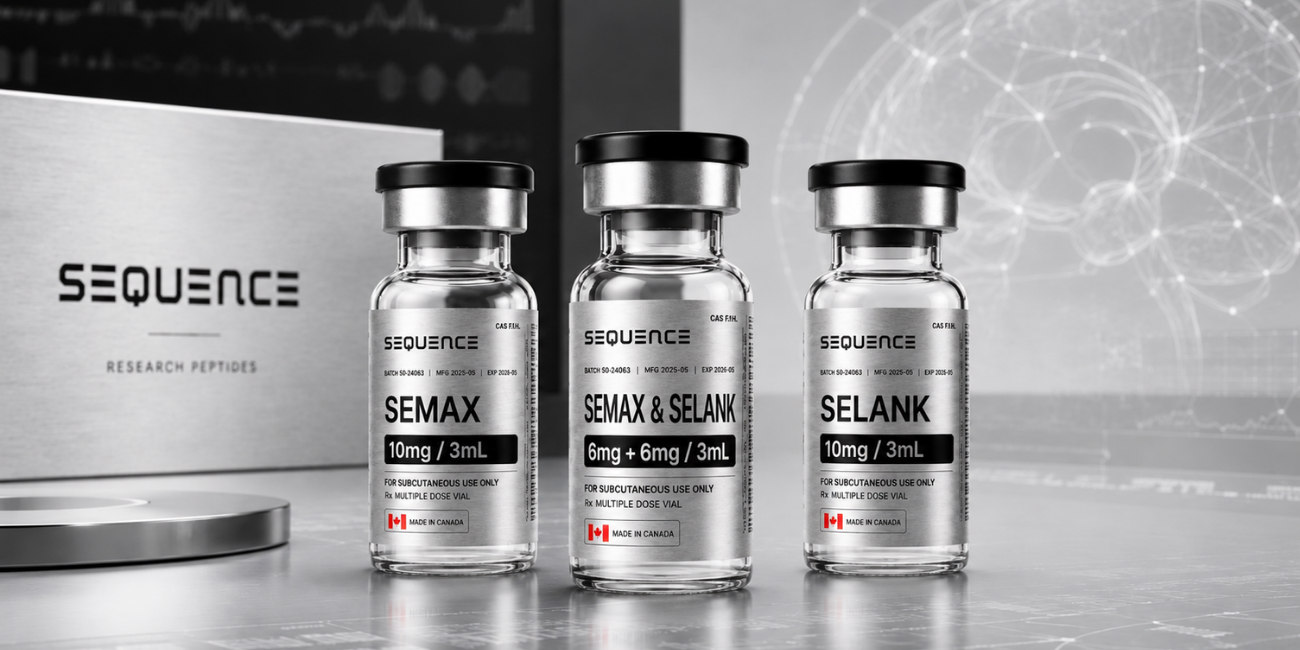
In the peptide market, Semax and Selank often travel together.
They show up in the same conversations around cognitive research, neurological signaling, stress response, attention, emotional regulation, and neuropeptide systems. That pairing makes sense at the category level – but it still deserves precision.
Semax and Selank are not the same compound.
They are not interchangeable.
They should not be flattened into “focus peptides” like the entire nervous system is just a productivity app with a blood supply.
A better way to understand the pairing is this:
Semax is often discussed more through cognitive and neurotrophic signaling. Selank is often discussed more through stress-response and regulatory signaling.
Different compounds.
Overlapping category.
Shared reason for comparison.
That is the product-pairing logic.
What Is Semax?
Semax is a synthetic peptide commonly described as an analogue of the ACTH fragment ACTH(4–10). It has been studied most often in relation to cognitive function, neuroprotective research, attention, memory, stress models, and neurotrophic signaling.
Research has explored Semax’s relationship with BDNF, or brain-derived neurotrophic factor, a signaling protein involved in neuronal plasticity and adaptation. One study suggested that Semax may affect cognitive brain functions by modulating hippocampal BDNF/TrkB system expression and activation.
Semax has also been studied in relation to changes in gene expression connected to neurotrophic factors such as Bdnf and Ngf in experimental models.
In simpler SEQUENCE language:
Semax is commonly discussed in cognitive peptide research because it appears in conversations around neurotrophic signaling, attention, memory, and neurological resilience.
That does not mean Semax should be marketed as a guaranteed cognitive enhancer or treatment.
It means its research context belongs in the Cognitive & Neurological category.
Clean line. Stay on it.
What Is Selank?
Selank is a synthetic peptide analogue of tuftsin, an endogenous immunomodulatory peptide fragment. It is commonly discussed in relation to stress-response research, anxiety-adjacent research contexts, emotional regulation, cognitive signaling, and neuroimmune systems.
Selank has been studied for effects on gene expression related to synaptic and neurotransmission-related processes, including research examining its influence on gene networks in rat hippocampus.
Other research has examined Selank’s possible anxiolytic mechanisms, including inhibition of enkephalin-degrading enzymes. A clinical-biological study compared Selank with medazepam in patients with generalized anxiety disorder and neurasthenia, reporting similar anxiolytic effects while also noting antiasthenic and psychostimulant effects in that study context.
The responsible framing is:
Selank is commonly discussed in stress-response and neurological peptide research because it appears in studies involving regulatory signaling, enkephalin-related pathways, and cognitive-emotional models.
Not:
Selank treats anxiety.
That second version walks into a regulatory rake.
Why Are Semax and Selank Often Paired?
Semax and Selank are often paired because they both sit inside the broader cognitive and neurological peptide category.
They are commonly discussed around:
- cognitive signaling
- attention and memory research
- neurological resilience
- stress-response systems
- neurotrophic factors
- peptide-based regulatory pathways
- mood and emotional-regulation models
But the overlap is not sameness.
A clean comparison looks like this:
| Compound | Common Research Emphasis |
|---|---|
| Semax | Cognitive signaling, neurotrophic factors, attention, memory, neurological resilience |
| Selank | Stress-response signaling, regulatory pathways, enkephalin-related mechanisms, cognitive-emotional models |
| Semax & Selank | Broader cognitive, neurological, and stress-response research pairing |
This is the logic behind offering them separately and together.
The single-compound formats allow focused comparison.
The combination format gives customers a structured way to compare the pairing directly.
No mystery stack.
No “limitless brain vial.”
No podcast goblin chemistry.
Just category logic.
Semax: The Cognitive and Neurotrophic Side of the Pairing
Semax is often discussed as the more cognitive-signaling-oriented side of the pairing.
Research conversations often include:
- neurotrophic factor expression
- BDNF and TrkB pathways
- attention models
- memory-related research
- neuronal survival under stress models
- neuroprotective and nootropic research language
That does not mean every Semax product should be described with sweeping cognitive claims.
The phrase “cognitive research” does not equal:
- guaranteed focus
- improved productivity
- treatment for attention disorders
- therapy for neurological disease
- personal performance promise
It means the compound is commonly discussed in research connected to those systems.
That is a more disciplined way to write about the category – and discipline is the entire point.
Selank: The Stress-Response and Regulatory Side of the Pairing
Selank is often discussed as the more stress-response and regulatory-signaling-oriented side of the pairing.
Research conversations often include:
- anxiolytic-adjacent research
- endogenous opioid / enkephalin-related pathways
- neurotransmission-related gene expression
- stress-response models
- emotional regulation contexts
- neuroimmune signaling
Selank is especially interesting because it does not sit neatly in one narrow box. It appears in cognitive, stress-response, emotional-regulation, and immune-signaling conversations.
That complexity is exactly why the language should stay careful.
A responsible product page or blog should not imply:
- it treats anxiety
- it replaces medication
- it guarantees calm
- it improves mood in a predictable way
- it functions the same way in all users or research contexts
The cleaner statement is:
Selank is commonly discussed in stress-response and cognitive-emotional peptide research.
Less flashy.
More accurate.
The nervous system is complicated enough without adding marketing jazz hands.
Single Compounds vs the Combined Pairing
SEQUENCE can present Semax and Selank in three clean formats:
Semax | 10mg / 3mL
A single-compound format for customers comparing Semax alone within the cognitive and neurological peptide category.
Selank | 10mg / 3mL
A single-compound format for customers comparing Selank alone within stress-response and neurological peptide research contexts.
Semax & Selank | 6mg + 6mg / 3mL
A combination format for customers comparing both compounds together within the broader cognitive and stress-response peptide category.
The product logic is simple:
| Format | Why It Exists |
|---|---|
| Semax alone | Focused comparison of Semax |
| Selank alone | Focused comparison of Selank |
| Semax & Selank | Direct comparison of the commonly paired format |
A combination vial should never hide the formula behind a vague blend name.
A label like:
Cognitive Blend | 12mg
is not clear enough.
A better format is:
Semax & Selank | 6mg + 6mg / 3mL
That tells the customer what is included, how much of each compound is present, and how the vial is structured.
The label should answer questions before it asks for trust.
Why Concentration Clarity Matters in Cognitive Pairings
Combination products need extra clarity because multiple compounds are involved.
For Semax & Selank, the label should make three things immediately clear:
- The vial contains Semax
- The vial contains Selank
- Each compound is present at a defined amount
That is why the format matters:
Semax & Selank | 6mg + 6mg / 3mL
This is cleaner than hiding the compounds inside a branded blend name.
It also helps customers compare:
- Semax alone
- Selank alone
- the combined pairing
- other cognitive and neurological peptide products
Confusion is not premium.
It is just bad labeling with better lighting.
What This Pairing Does Not Mean
Semax and Selank being paired does not mean the combination is a guaranteed outcome machine.
It does not mean:
- guaranteed focus
- improved memory
- reduced anxiety
- better mood
- treatment of neurological conditions
- treatment of psychiatric conditions
- replacement for medical care
- a personal-use protocol
- more compounds automatically equals better
The responsible interpretation is:
Semax and Selank are often paired because they are both commonly discussed in cognitive, neurological, and stress-response peptide research, with different but overlapping areas of interest.
That is the line.
SEQUENCE should stay on that line.
Cognitive Pairings Need Cleaner Language
Semax and Selank are often paired because they sit within overlapping cognitive and neurological research conversations.
Semax is usually discussed more through neurotrophic, attention, memory, and neurological resilience pathways.
Selank is usually discussed more through stress-response, regulatory, enkephalin-related, and cognitive-emotional research contexts.
Together, they form one of the more recognizable pairings in the cognitive peptide category.
But recognition is not the standard.
The standard is:
- clear compound identity
- defined concentration
- single-compound options
- combination format clarity
- batch traceability
- testing and verification
- disciplined product language
No “limitless” nonsense.
No productivity-miracle costume.
No brain-hack circus tent.
Just cleaner information for customers comparing cognitive peptide products.
That is SEQUENCE.