
Lyophilized vs Reconstituted Peptides: What Changes After Preparation
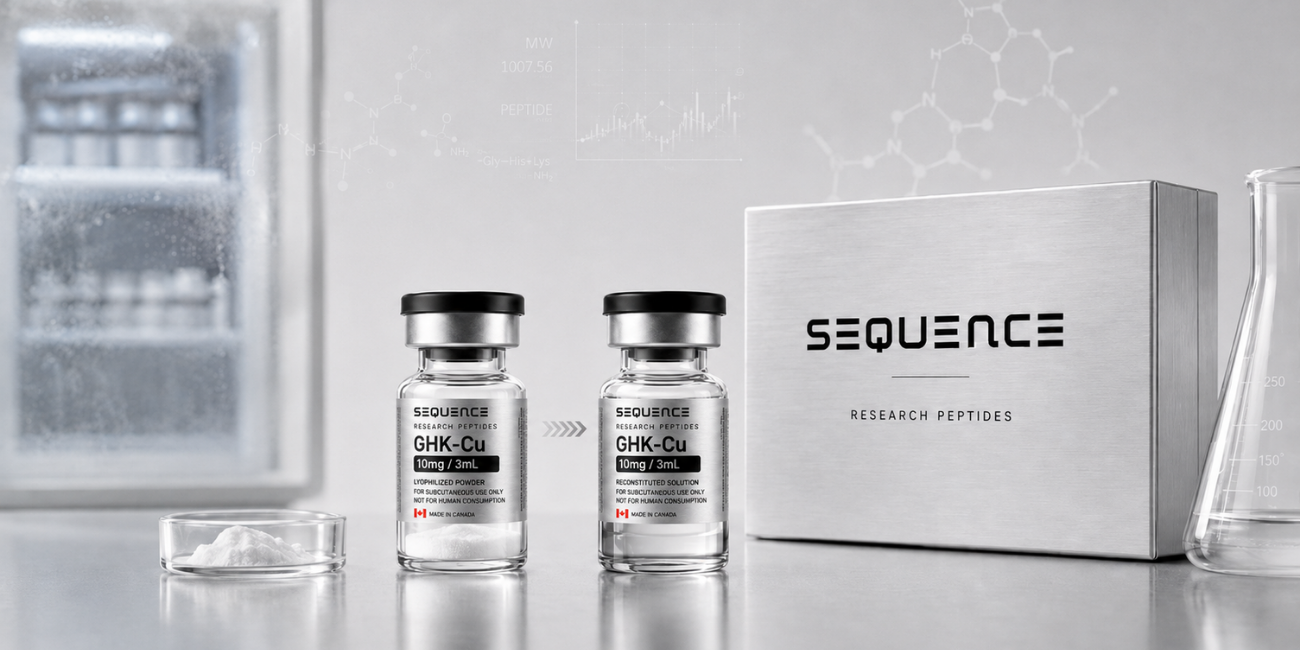
Peptide products are often discussed as if the vial is the whole story.
It is not.
A peptide vial can exist in two very different states:
lyophilized and reconstituted.
Those two words matter because the product’s handling expectations change after preparation. Storage, temperature sensitivity, moisture exposure, and product integrity all become more important once a peptide has moved from dry powder to liquid solution.
This guide explains the difference without turning the subject into a ritual, a panic spiral, or a forum ceremony conducted by someone named “researchalpha1994.”
Just the practical difference between powder and solution – and why it matters.
What Does Lyophilized Mean?
Lyophilized means freeze-dried.
In simple terms, lyophilization is a process that removes water from a material under controlled low-temperature and low-pressure conditions. For peptide products, this often leaves behind a dry powder, cake, or puck inside the vial.
That dry format is commonly used because many sensitive compounds are more stable when moisture is removed.
A lyophilized peptide vial may look like:
- a compact white puck
- a thin powder layer
- a crystalline or fluffy powder
- a small amount of dry residue at the bottom or side of the vial
The exact appearance can vary depending on the compound, formulation, fill process, and how the vial settled during manufacturing or shipping.
The visual appearance alone should not be treated as a full quality assessment. A clean-looking puck does not replace batch testing, and a slightly different-looking powder does not automatically mean a product is compromised.
That is why testing, labeling, and storage guidance all matter.
What Does Reconstituted Mean?
Reconstituted means the dry peptide powder has been mixed with a liquid diluent.
In the peptide market, that liquid is often bacteriostatic water, depending on the product format and intended research context.
Once a peptide has been reconstituted, it is no longer in its dry lyophilized form. It is now a liquid solution.
That change matters.
A dry compound and a liquid solution should not be treated the same way. Moisture, temperature, light exposure, and contamination risk become much more relevant after reconstitution.
This is where product care becomes part of the standard.
Lyophilized vs Reconstituted: The Simple Difference
| State | What It Means | General Handling Focus |
|---|---|---|
| Lyophilized | Dry freeze-dried peptide powder | Protect from heat, light, moisture, and rough storage conditions |
| Reconstituted | Peptide mixed into liquid solution | Refrigeration, cleanliness, limited exposure, and careful product care become more important |
The key difference is simple:
Lyophilized peptides are dry. Reconstituted peptides are in solution.
That one change affects how the product should be stored, handled, and understood.
Why Peptides Are Supplied as Lyophilized Powder
Many peptide products are supplied in lyophilized form because dry storage can help protect sensitive compounds before preparation.
Removing water can help reduce certain degradation risks and improve shelf stability compared to a prepared liquid solution. This is especially relevant for products that may spend time in transit, storage, or inventory before use.
For customers, this means the vial may arrive as a dry material rather than a ready-to-use liquid.
That is intentional.
A lyophilized format helps separate two stages:
- storage before preparation
- handling after preparation
Those stages have different expectations.
What Changes After Reconstitution?
Once a peptide has been reconstituted, several things change.
The product becomes more vulnerable to factors that were less immediate when it was dry.
1. Moisture Is Now Present
This is the most obvious change.
A lyophilized peptide is dry. A reconstituted peptide is now in liquid solution.
Moisture can influence stability, degradation, and microbial risk depending on the product and storage conditions. That is why reconstituted products are generally treated with more care.
Once liquid enters the equation, the casual handling window gets smaller.
2. Refrigeration Becomes More Important
Lyophilized peptides are often stored cold or in controlled conditions, depending on product guidance.
After reconstitution, refrigeration generally becomes more important because liquid solutions are more sensitive than dry powders.
The exact storage requirement can vary by compound, formulation, diluent, and supplier guidance, but the broad principle remains:
A reconstituted vial usually requires stricter temperature control than a dry lyophilized vial.
Heat is not your friend here. It rarely is. Heat is the guy at the party saying, “Relax, it’ll be fine,” shortly before making everything worse.
3. Repeated Temperature Swings Matter More
Temperature swings can affect sensitive compounds.
A vial repeatedly moving between warm and cold conditions may experience more stress than a vial kept consistently within an appropriate range.
This matters especially after reconstitution because liquid solutions can be more vulnerable to degradation over time.
The practical principle:
- avoid unnecessary warming
- avoid leaving vials out longer than needed
- avoid repeated room-temperature exposure
- store according to the product’s guidance
Consistency is the goal.
4. Light Exposure Should Be Limited
Peptides and related compounds may be sensitive to light depending on their structure and formulation.
That does not mean every vial needs to be treated like a vampire prince. But it does mean direct sunlight and unnecessary light exposure are not helpful.
A clean storage approach usually includes:
- keeping vials in their box or protective container
- avoiding bright direct light
- storing in a cool, controlled place
- minimizing unnecessary handling
Again: boring, controlled, effective.
5. Clean Handling Becomes More Important
Before reconstitution, the peptide is sealed as a dry product.
After reconstitution, the vial has entered a more sensitive handling stage.
This is why clean handling principles matter. The goal is to reduce unnecessary contamination risk, exposure, and product stress.
This article is not a personal administration guide. It is not here to teach medical technique or procedural use.
The SEQUENCE position is simpler:
Once a product has been prepared, handling discipline matters more.
6. Time Becomes a Bigger Factor
A lyophilized vial is generally designed for storage before preparation.
A reconstituted vial is not the same thing.
Once a product has been prepared into solution, time becomes more relevant. The product should be stored according to guidance and not treated as if it has the same stability profile as the dry vial.
This is why customers should avoid preparing products before they understand storage expectations.
Preparation without storage knowledge is not efficiency. It is just confidence with poor lighting.
Common Mistakes After Reconstitution
This category exists because small handling mistakes are common.
Not because people are stupid — because the market often explains products poorly.
Mistake 1: Treating the liquid vial like the dry vial
A dry vial and a liquid vial are not the same handling situation.
Once reconstituted, refrigeration, cleanliness, and limited exposure matter more.
Mistake 2: Leaving the vial out unnecessarily
Short handling periods are different from leaving a vial sitting around.
Avoid unnecessary room-temperature exposure, especially after preparation.
Mistake 3: Storing near heat
Do not store peptide products near:
- windows
- heaters
- hot vehicles
- direct sunlight
- warm countertops
- electronics that generate heat
The vial does not need a spa day.
Mistake 4: Repeatedly warming and cooling
Consistent storage is better than repeated temperature changes.
Avoid cycling a product between warm and cold conditions more than necessary.
Mistake 5: Ignoring supplier guidance
Different compounds may have different handling expectations.
Always defer to product-specific guidance, testing documentation, storage labels, and professional advice where applicable.
What Bacteriostatic Water Has to Do With It
Bacteriostatic water is commonly discussed alongside peptide preparation because it is often used as a diluent for reconstitution.
The word bacteriostatic means it contains an agent intended to inhibit bacterial growth within the water itself.
That does not make it magic water.
It does not make poor handling irrelevant.
It does not replace clean storage principles.
It is simply part of the preparation conversation for many peptide products.
For SEQUENCE, bacteriostatic water should be presented clearly as an accessory with defined volume, labeling, and storage context – not as a mysterious add-on that customers are expected to decode through Reddit archaeology.
How SEQUENCE Frames Product Care
SEQUENCE approaches preparation and handling from a simple belief:
Product care is part of product quality.
A vial can be well-labeled, properly formatted, and batch-tracked – but customers still need to understand how storage and preparation change the product’s handling expectations.
That means SEQUENCE should make the following easy to understand:
- whether a product is lyophilized
- what the total vial content is
- what the vial format is
- how the product should be stored before preparation
- how storage changes after reconstitution
- what accessories are commonly associated with preparation
- where testing and verification information can be found
This is not about making the process intimidating.
It is about removing guesswork.
Before Preparation: What Customers Should Understand
Before any product is prepared, customers should understand:
1. The product format
Is it lyophilized powder?
Is it already liquid?
Is it a single-compound or combination product?
2. The labeled amount
For example:
BPC-157 | 10mg / 3mL
or:
BPC-157 & TB-500 | 5mg + 5mg / 3mL
The label should make the total compound amount and vial format clear.
3. Storage expectations
Customers should know how to store the product before and after preparation.
This information should not be hidden behind support tickets or vague supplier folklore.
4. Testing and verification status
Customers should be able to find batch testing information or understand how SEQUENCE displays verification results when available.
5. Accessory requirements
Customers should understand the role of accessories like bacteriostatic water and syringes without being pushed into unsafe procedural guidance.
A clean product ecosystem makes the surrounding tools clear.
What This Article Is Not
This article is not:
- a dosing guide
- a medical instruction page
- an injection tutorial
- a treatment recommendation
- a substitute for professional guidance
- a personal-use protocol
It is a product education guide explaining the difference between lyophilized and reconstituted peptide states.
That distinction matters.
SEQUENCE can educate without pretending to be a clinic, a forum, or a man in a tank top explaining “advanced protocols” beside a microwave.
The Vial Changes When the State Changes
The main idea is simple:
Lyophilized peptides and reconstituted peptides are not handled the same way.
Before preparation, the product exists as a dry freeze-dried material. After preparation, it becomes a liquid solution with different storage and handling expectations.
That change affects:
- temperature control
- moisture exposure
- handling discipline
- storage consistency
- time sensitivity
- product care
Good product education does not stop at the label.
It continues into storage, preparation, and handling – because sensitive compounds deserve more than confidence and a junk drawer.