
How Peptide Testing Works: HPLC, LC-MS, COAs, and Janoshik Verification
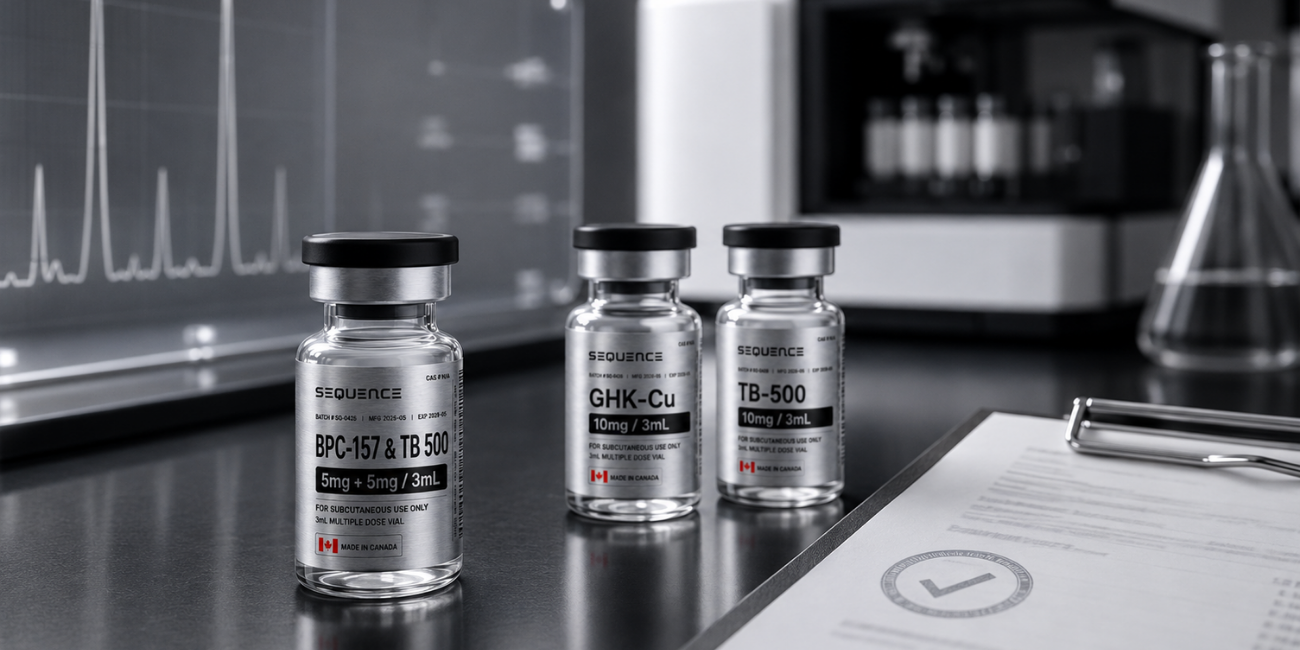
The peptide market has plenty of confidence.
Confidence is cheap.
A product page can say high purity.
A label can look polished.
A supplier can claim the compound is exactly what it says it is.
A screenshot can be uploaded beside a product and dressed up like proof.
But testing is where confidence either gets structure – or quietly starts sweating.
Peptide testing exists to help connect a product claim to measurable analysis. It does not turn a product into an approved medicine. It does not guarantee every possible safety variable. It does not replace responsible handling, batch traceability, or clear product documentation.
But it does matter.
For SEQUENCE, testing and verification are part of the product standard: clear compound identity, defined concentration, batch-specific reporting, and third-party verification wherever available.
No mystery vial.
No purity number worship.
No PDF theatre.
Just better receipts.
Why Peptide Testing Matters
Peptide products are often sold in a market where trust is requested before evidence is provided.
That is backwards.
A responsible product system should help customers answer basic questions:
- Is the compound what the label says it is?
- How much material is present?
- What level of purity was reported?
- What method was used?
- Which batch was tested?
- Can the report be verified?
- Does the product page match the test result?
Testing does not answer every possible question, but it reduces uncertainty.
That distinction matters.
Testing reduces uncertainty. It does not eliminate responsibility.
A clean test result is useful. A clear label is useful. A batch number is useful. A verifiable report is useful.
Together, they create accountability.
Alone, each one is easier to misread, misuse, or turn into marketing confetti.
Who Is Janoshik?
Janoshik is an independent analytical testing laboratory that publicly describes its work as chemical analysis for steroids, peptides, and pharmaceutical compounds. Its website includes a dedicated peptide testing category described as “comprehensive purity and composition analysis of research peptides.”
SEQUENCE uses Janoshik because third-party testing creates separation between the seller and the result.
That separation matters.
A supplier saying “trust us” is not the same as a lab report tied to a test method, task number, unique verification key, and batch-specific result.
Janoshik also operates a public verification page where users can verify the authenticity of a test using a task number and unique key.
That is the part customers should pay attention to.
A screenshot is weak.
A verifiable report is stronger.
Because yes, people can edit PDFs. Humanity remains undefeated in the dumbest ways.
What Peptide Testing Can Look At
Depending on the compound and test selected, peptide analysis may evaluate several different things.
Common testing categories include:
| Testing Area | What It Helps Assess |
|---|---|
| Identity | Whether the sample matches the expected compound |
| Amount | How much target compound is present |
| Purity | How much of the detectable material appears to be the target compound under the chosen method |
| Composition | What the sample appears to contain |
| Contamination screening | Whether other peptides or degraded peptide may be detected |
| Sterility testing | A separate test category when selected |
Janoshik’s peptide listings include purity and composition analysis for research peptides, and some peptide analysis pages list LC-MS screening as an optional contamination screen for other peptides or degraded peptide, with stated limitations.
The key point:
A test is only as useful as the method selected and the sample submitted.
A purity test is not automatically a sterility test.
An identity test is not automatically a full contamination screen.
A COA is not automatically a medical safety profile.
Testing has to be read with context.
What Is HPLC?
HPLC stands for High-Performance Liquid Chromatography.
In simple terms, HPLC is a laboratory technique used to separate components in a sample. Once separated, the lab can evaluate the main target compound relative to other detectable components under that method.
For peptide products, HPLC is commonly associated with purity analysis.
A simplified explanation:
HPLC helps show how much of the detectable sample appears to be the target compound compared to impurities or other peaks.
This is where many peptide purity percentages come from.
For example, if a COA reports a peptide at 99.72% purity, that number usually refers to the result produced under the testing method used. It should be interpreted with the method, sample, chromatogram, and batch information – not treated like a magic seal from the purity gods.
What an HPLC Chromatogram Shows
An HPLC report often includes a chromatogram.
A chromatogram is a visual output showing peaks over time. Each peak represents material detected as it passes through the system.
A simplified way to read it:
| Chromatogram Feature | Basic Meaning |
|---|---|
| Large main peak | Usually the target compound |
| Smaller peaks | Potential impurities, related substances, degradation products, or other detectable components |
| Retention time | When a component appears during the run |
| Peak area | Used in calculating relative purity |
This does not mean a customer needs to become a chromatographer before buying a vial.
It just means the report should show more than a number.
A purity percentage without the supporting method and chromatogram is like a résumé with no work history. Bold, but suspicious.
What Is LC-MS?
LC-MS stands for Liquid Chromatography–Mass Spectrometry.
It combines two analytical tools:
| Tool | Role |
|---|---|
| Liquid Chromatography | Separates components in the sample |
| Mass Spectrometry | Helps identify compounds based on mass-related data |
In peptide testing, LC-MS is often discussed around identity confirmation, contamination screening, and detecting other peptides or degraded peptide material.
Janoshik’s peptide pages note that LC-MS screening can detect contamination with other peptides and degraded peptide, while also stating that detection is limited to peptides on their price list and that some results provide identification only unless concentration measurement is added.
A clean way to frame it:
HPLC helps assess purity. LC-MS helps support identity and contamination analysis.
That is not the whole laboratory textbook, but it is the customer-useful version.
HPLC vs LC-MS: What Is the Difference?
HPLC and LC-MS are related, but they do not answer exactly the same question.
| Method | Main Use in Peptide Testing |
|---|---|
| HPLC | Separates sample components and helps calculate relative purity |
| LC-MS | Separates and identifies compounds using mass-related data |
| HPLC-UV | Uses UV detection to evaluate peaks after separation |
| LC-MS screening | Helps detect other peptides or degraded peptide where covered by the lab’s method/database |
The important point is this:
Purity and identity are related, but they are not the same thing.
A sample can produce a clean-looking main peak.
But the customer still needs confidence that the peak corresponds to the intended compound.
That is why testing strategy matters.
Clean peak. Correct compound. Defined batch. Verifiable report.
That is the structure.
What Is a Certificate of Analysis?
A Certificate of Analysis, or COA, is the document that summarizes a lab test result.
A peptide COA may include:
- compound name
- sample name
- batch number or sample ID
- test date
- testing method
- purity result
- amount or content result
- chromatogram
- lab name
- task number
- verification key
- notes or limitations
A COA should not be treated as decoration.
It is not there to make the product page look “sciencey.”
It should help customers connect the product they are viewing to the test that was performed.
That connection is the entire point.
What a COA Can Help Confirm
A COA can help support:
| COA Detail | Why It Matters |
|---|---|
| Compound identity | Helps confirm the sample matches the expected compound |
| Purity result | Shows relative purity under the chosen method |
| Amount/content | Helps confirm how much target material is present |
| Batch traceability | Connects the report to a specific batch |
| Test method | Shows how the result was generated |
| Verification details | Helps confirm authenticity through the lab |
The strongest reports are not just screenshots.
They are verifiable, method-specific, and tied to a product batch.
What a COA Does Not Prove
This section matters.
A COA does not automatically prove:
- the product is approved for human use
- the product treats or cures anything
- every vial ever made is identical
- storage and handling were perfect after testing
- the product is sterile unless sterility testing was performed
- the supplier’s entire operation is flawless
- the compound is appropriate for any personal situation
- all possible impurities were screened under every possible method
That does not make COAs useless.
It makes them specific.
A COA is a tool.
Not a halo.
Testing creates accountability, but it should not be stretched beyond what the method actually measured.
Janoshik Verification: Why the Task Number and Unique Key Matter
Janoshik provides a public verification page where users can enter a task number and unique key to verify the authenticity of a test conducted by the company.
This matters because a report screenshot can be copied, cropped, edited, or reused.
A proper verification step allows customers to confirm that the report exists through the lab’s own system.
When reviewing a Janoshik report, customers should look for:
- Task number
- Unique key
- Compound name
- Test method
- Reported result
- Test date
- Batch or sample identifier
- Product page match
If a seller provides a report but removes the verification details, that should raise questions.
Not panic.
Questions.
Because a testing claim without verification is still asking the customer to trust the seller’s screenshot.
And screenshots are not a standard. They are a file format.
How to Read a Peptide Testing Result
A customer does not need to understand every technical detail to use testing information responsibly.
Start with these five questions:
1. What compound was tested?
The report should match the product name.
If the product page says BPC-157, the report should clearly reference BPC-157.
2. What batch was tested?
The batch number should connect the report to the product being sold.
This is what prevents a supplier from waving around one old test forever like it blesses every future batch.
3. What method was used?
HPLC, HPLC-UV, LC-MS, sterility testing, and other methods answer different questions.
The method matters.
4. What result was reported?
Look at the purity, amount, identity, or contamination result depending on the test type.
Do not interpret every number as the same kind of result.
5. Can the report be verified?
If the report is from Janoshik, look for the task number and unique key so it can be checked through their verification page.
Common Testing Red Flags
A testing page should make customers more informed, not more easily impressed.
Watch for:
- purity claims with no report
- report screenshots with no verification details
- batch numbers that do not match product labels
- old COAs reused across multiple batches
- vague “third-party tested” language with no lab named
- purity percentage shown without method
- no chromatogram or report detail
- reports that do not match the compound being sold
- “tested” used as a blanket claim for things not actually tested
The phrase third-party tested should be a starting point.
Not the finish line.
The SEQUENCE Approach to Testing & Verification
SEQUENCE’s testing approach should be simple:
- use third-party analysis
- display results clearly
- connect reports to batches
- identify the lab
- show the method
- provide verification where possible
- avoid claims the test does not support
- make testing part of the product page structure
This is not about making the product look more scientific.
It is about making the product easier to evaluate.
The peptide market does not need louder promises.
It needs better documentation.
View SEQUENCE Testing & Verification
SEQUENCE uses third-party testing to support product clarity, batch accountability, and verification across the catalogue.
Review available lab results, purity reports, batch numbers, testing methods, and Janoshik verification links before comparing products.