
GHK-Cu: Copper, Skin Architecture, and the Language of Repair
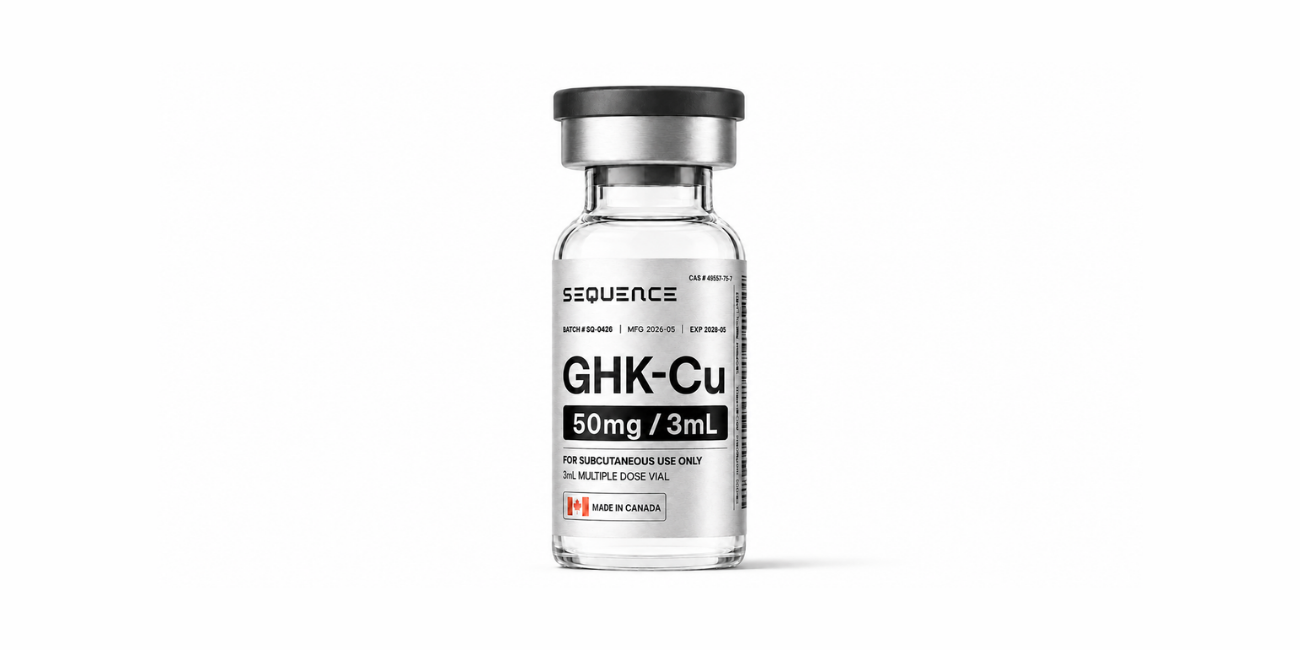
There are compounds that feel loud by reputation — pushed into conversations around performance, transformation, and rapid results.
GHK-Cu is different.
It is quieter. More architectural. Less about brute-force stimulation and more about the body’s maintenance language.
GHK-Cu, often called a copper peptide, is a naturally occurring complex formed when the tripeptide GHK — glycine, histidine, and lysine — binds copper. This copper-bound form has been studied for its relationship to skin structure, tissue remodeling, extracellular matrix activity, and repair signaling.
Not magic.
Not mythology.
Not “anti-aging” glitter thrown at a serum bottle.
More like a maintenance instruction.
A quiet message to the architecture crew.
What Is GHK-Cu?
GHK-Cu stands for glycyl-L-histidyl-L-lysine copper.
The peptide portion, GHK, is made from three amino acids: glycine, histidine, and lysine. When it binds copper, it forms the biologically active complex known as GHK-Cu.
Copper is not just a background mineral. It plays a role in enzymatic systems connected to connective tissue structure, antioxidant defense, blood vessel formation, and extracellular matrix stability.
That matters because skin is not just a surface.
Skin is structure.
It is collagen scaffolding, elastin tension, hydration networks, fibroblast behavior, immune tone, vascular supply, and constant remodeling. It is a living barrier exposed to light, friction, inflammation, oxidation, dryness, and time.
GHK-Cu is interesting because it sits inside that repair conversation.
Its appeal is not that it belongs to skincare culture.
Its appeal is that it has a coherent biological identity: a copper-bound peptide complex associated with tissue remodeling, dermal signaling, and structural repair pathways.
Skin Is Architecture, Not Decoration
Most skin conversations are shallow.
Glow. Texture. Wrinkles. Before and after. Another bottle. Another promise. Another ring-light sermon from someone spiritually sponsored by retinol.
But biologically, skin is not cosmetic first.
Skin is architecture.
The visible surface is only the outer report. Beneath it, the dermis contains the structural proteins and cellular systems that determine resilience, elasticity, firmness, wound response, and tissue quality.
Fibroblasts produce many of the key extracellular matrix components that give skin its structure, including:
| Component | Role |
|---|---|
| Collagen | Provides tensile strength and support |
| Elastin | Supports elasticity and recoil |
| Glycosaminoglycans | Help retain hydration and support matrix organization |
| Fibroblasts | Produce and remodel structural matrix components |
GHK-Cu is often discussed in relation to these fibroblast-linked processes, including collagen, elastin, and glycosaminoglycan synthesis.
That is the stronger conversation.
Not:
“How do we make skin look younger?”
But:
What signals help skin maintain structure?
What molecules participate in remodeling?
How does the body coordinate repair after damage?
How does copper fit into that process?
GHK-Cu belongs in that conversation because it is not simply a cosmetic ingredient. It is a biochemical signal tied to repair biology and tissue maintenance.
Copper: The Mineral Behind the Signal
The “Cu” in GHK-Cu is not decorative.
It is copper.
Copper participates in biological systems that matter for tissue structure, including extracellular matrix formation, antioxidant enzyme activity, and vascular support.
This gives GHK-Cu part of its identity.
The peptide is not only a string of amino acids. It is a copper-binding structure that places copper biology into a signaling context.
Copper on its own is a mineral.
GHK on its own is a peptide.
Together, GHK-Cu becomes a molecular complex associated with repair signaling, matrix remodeling, and structural maintenance.
The body often works this way.
Not through isolated ingredients doing isolated things, but through complexes, carriers, cofactors, enzymes, gradients, and signals.
Biology prefers relationships.
GHK-Cu appears to operate less like a hammer and more like a coordinator.
It is discussed in relation to:
- fibroblast activity
- collagen and elastin synthesis
- glycosaminoglycan production
- wound-healing models
- antioxidant pathways
- inflammatory signal regulation
- repair-associated gene expression
That is why the compound keeps appearing in conversations around skin, connective tissue, aesthetics, and regenerative research.
Not because it is trendy.
Because the mechanism has depth.
GHK-Cu and the Extracellular Matrix
To understand GHK-Cu, you have to understand the extracellular matrix, often shortened to ECM.
The ECM is the structural environment surrounding cells. It is not dead scaffolding. It is active, responsive, and constantly remodeled.
In skin, the ECM helps determine firmness, elasticity, hydration, and the tissue’s ability to respond to damage or stress.
GHK-Cu is often associated with extracellular matrix remodeling, including collagen, elastin, and glycosaminoglycan synthesis.
This matters because repair is not just production.
Healthy remodeling requires both clearing and rebuilding.
The body has to remove damaged or disorganized matrix while producing new structural material. If the system only builds, tissue can become chaotic. If it only breaks down, tissue loses integrity.
Repair is controlled renovation.
Demolition and rebuild.
Clearance and replacement.
Signal and structure.
GHK-Cu is compelling because it is not best understood as a single-action compound. It belongs to a broader remodeling language.
Beyond “More Collagen”
A lazy version of the GHK-Cu conversation would be:
“GHK-Cu increases collagen.”
That may be part of the research discussion, but it is incomplete.
The better framing is:
GHK-Cu is associated with extracellular matrix remodeling, including collagen, elastin, glycosaminoglycans, fibroblast activity, and broader repair-related signaling.
That distinction matters.
Biology is rarely about “more” in a simple sense.
More collagen is not automatically better.
More inflammation is not automatically worse.
More growth is not automatically repair.
More signal is not automatically intelligence.
The real question is coordination.
GHK-Cu is interesting because it appears connected to several layers of that coordination: copper binding, fibroblast behavior, matrix synthesis, antioxidant response, and repair-associated gene expression.
That is a much stronger story than “skin peptide makes skin good.”
That is brochure language.
We can leave that to the beige brands with leaf icons and fake clinical lighting.
The Language of Repair
Repair is not one event.
It is a language.
Inflammatory signals call attention to damage.
Fibroblasts respond.
Matrix proteins are produced.
Old or damaged material is broken down.
New structure is laid down.
Blood supply adapts.
Oxidative stress is managed.
The tissue reorganizes.
GHK-Cu is compelling because it appears to participate in several parts of this language.
It speaks copper.
It speaks matrix.
It speaks fibroblast.
It speaks structure.
That is why it belongs in the SEQUENCE conversation.
Not as a promise.
As a compound with a clear biological identity.
How to Think About GHK-Cu
GHK-Cu is best understood as a copper-bound signaling peptide associated with tissue architecture.
Its core themes are:
Copper Binding
GHK binds copper and forms a biologically relevant peptide-mineral complex.
Extracellular Matrix Remodeling
GHK-Cu is associated with collagen, elastin, and glycosaminoglycan activity — key components of dermal structure.
Fibroblast Activity
Fibroblasts are central to skin architecture because they produce and organize the extracellular matrix.
Repair Signaling
GHK-Cu is frequently discussed in relation to wound-healing models, tissue remodeling, and repair-associated pathways.
Structural Maintenance
Its identity is less about cosmetic surface change and more about the deeper biology of tissue organization.
Not a miracle.
Not a slogan.
Not “glow in a vial.”
A copper-peptide signal tied to structure, repair, and the body’s ongoing attempt to keep the architecture intact.
GHK-Cu is best understood as a structural signal.
Its importance is not that it belongs to the world of skincare, aesthetics, or peptide culture. Its importance is that it sits at the intersection of copper biology, extracellular matrix remodeling, fibroblast function, and repair-associated signaling.
Skin is the visible layer.
The deeper story is architecture.
GHK-Cu reminds us that repair is not brute force. It is not simply growth, stimulation, or acceleration.
Repair is coordination.
It is controlled remodeling.
It is the body deciding what to clear, what to rebuild, and how to restore structure without chaos.
A small peptide.
A copper ion.
A quiet instruction.
That is the language of repair.