
BPC-157 & TB-500: Why These Peptides Are Often Discussed Together
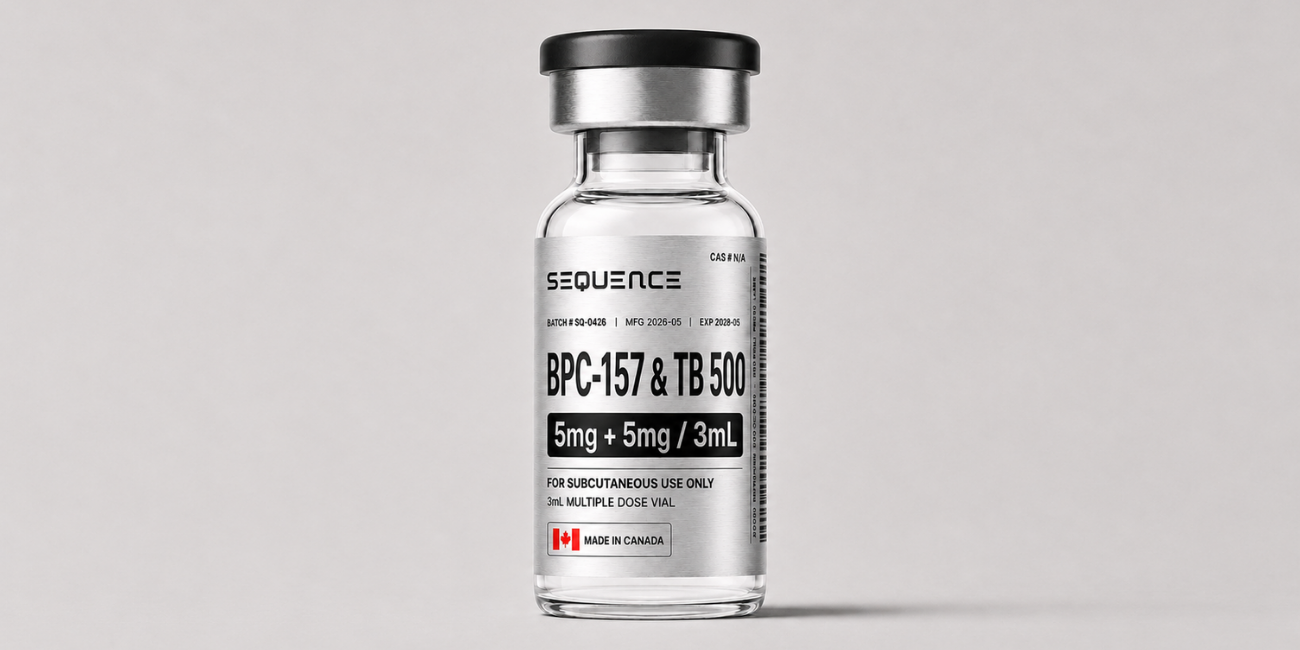
In the peptide market, few combinations are mentioned as often as BPC-157 and TB-500.
They usually appear in conversations around recovery, soft tissue stress, connective tissue research, mobility, and repair-related pathways. That popularity has also created a lot of noise. Some of it is grounded in preclinical research. Some of it is forum mythology wearing a lab coat it absolutely did not earn.
This guide breaks down why these two compounds are commonly grouped together, what separates them, and how to think about the pairing without turning research language into reckless promises.
What Is BPC-157?
BPC-157 is a synthetic peptide sequence often described as a gastric pentadecapeptide, meaning it is made up of 15 amino acids and is related to a protective protein sequence found in gastric juice.
In research discussions, BPC-157 is most often associated with:
- soft tissue repair models
- tendon and ligament research
- gastrointestinal protection pathways
- angiogenesis and vascular response
- inflammation-related signaling
- tissue resilience under stress
A growing body of preclinical literature has examined BPC-157 in models involving tendon, ligament, muscle, nerve, gastrointestinal, and vascular injury pathways. However, much of the available evidence remains animal-based or experimental, with limited human clinical data. That distinction matters. The lab is not the same as the real world. The rat is not your cousin who pulled his hamstring doing ego deadlifts.
What Is TB-500?
TB-500 is commonly discussed in relation to thymosin beta-4, a naturally occurring peptide involved in cell migration, actin regulation, tissue remodeling, and repair-related signaling.
Thymosin beta-4 has been studied for its role in:
- wound healing
- cell migration
- angiogenesis
- tissue protection
- dermal repair
- regenerative signaling
Several studies and reviews have explored thymosin beta-4’s role in wound healing and tissue repair, including dermal healing models and clinical wound research. TB-500 is commonly marketed as a synthetic peptide related to this pathway, though it is important to separate direct TB-500 claims from the broader thymosin beta-4 literature. The two are often discussed together, but they should not be treated as scientifically identical without qualification.
Why Are BPC-157 and TB-500 Often Paired?
BPC-157 and TB-500 are often grouped together because they are both discussed in relation to repair biology, but they are usually framed as acting through different angles.
A simple way to think about the pairing:
| Compound | Common Research Focus |
|---|---|
| BPC-157 | localized tissue repair, tendon/ligament models, vascular response, gastrointestinal protection |
| TB-500 | cell migration, tissue remodeling, actin-related repair pathways, wound healing research |
The pairing is appealing because recovery is not one pathway. Tissue stress involves inflammation, blood flow, cellular migration, collagen organization, oxidative stress, immune response, and structural remodeling.
So the logic behind the combination is not:
“Two healing peptides equals magic.”
It is closer to:
“These compounds are often discussed in overlapping repair-related research categories, with different proposed mechanisms.”
Less wizard robe. More mechanism map.
BPC-157: The Local Repair Conversation
BPC-157 is often discussed as the more localized repair-oriented compound in the pairing.
Research interest commonly focuses on how BPC-157 may interact with:
- tendon fibroblasts
- ligament healing models
- angiogenesis
- nitric oxide pathways
- inflammatory response
- gastrointestinal barrier protection
- vascular adaptation after injury
This is why BPC-157 tends to appear in conversations around tendon strain, soft tissue stress, and connective tissue research.
However, SEQUENCE should be very clear here: interest does not equal approval, and preclinical evidence does not equal proven human outcome. BPC-157 has not been approved by major regulators for human clinical use, and sport organizations have treated it as a prohibited non-approved substance in competition contexts.
TB-500: The Remodeling and Mobility Conversation
TB-500 is typically positioned as the more systemic tissue remodeling side of the pairing.
Because of its association with thymosin beta-4 pathways, TB-500 is commonly discussed in relation to:
- cell migration
- wound healing
- actin binding
- tissue remodeling
- angiogenesis
- flexibility and mobility research
Thymosin beta-4 has been described in scientific literature as a multifunctional peptide involved in repair and regeneration processes, particularly in tissue protection, cell migration, and dermal healing models.
That said, many online TB-500 claims lean heavily on thymosin beta-4 research without always making the distinction cleanly. This is where the market gets slippery. Similar pathway does not automatically mean identical evidence.
Why Combination Vials Exist
Combination vials exist because some compounds are commonly discussed together under the same research category.
For BPC-157 and TB-500, that category is usually:
Recovery & Repair
A combined format can offer a cleaner presentation for customers who are already comparing these compounds side by side. Instead of two separate vials, two separate labels, and two separate concentration formats, a combination vial presents the pairing as one structured product.
For SEQUENCE, the focus is not just the combination itself. The focus is:
- clear compound names
- clear concentration
- clear vial format
- clear batch tracking
- clear testing standards
- clean product presentation
Because in this market, “contains peptide” is not enough. That is the bare minimum. Congratulations, the vial has contents. Civilization trembles.
Why Concentration Clarity Matters
A BPC-157 and TB-500 product should make the concentration immediately understandable.
For example:
BPC-157 & TB-500 | 5mg + 5mg / 3mL
That tells the customer:
- the vial contains BPC-157
- the vial contains TB-500
- each compound is present at 5mg
- the total vial format is 3mL
- the product is presented as a combination formula
This kind of clarity matters because vague peptide labeling creates confusion. Confusion creates mistakes. Mistakes create risk. And risk is not a brand identity.
Continue Exploring Recovery & Repair Peptides
BPC-157 and TB-500 are often discussed together, but they can also be approached as separate compounds depending on what someone is comparing, researching, or organizing within their own product selection.
SEQUENCE offers each format with clear compound identification, defined concentration, batch traceability, and disciplined product presentation – because comparison should be clean before a customer ever reaches checkout.
BPC-157
A single-compound option commonly discussed in relation to localized repair, connective tissue research, gastrointestinal pathways, and recovery-focused peptide conversations.
BPC-157 | 10mg / 3mL
View BPC-157 →
BPC-157 & TB-500
A dual-compound pairing for customers comparing both peptides within the broader category of recovery, repair, mobility, and tissue-remodeling research.
BPC-157 & TB-500 | 5mg + 5mg / 3mL
View BPC-157 & TB-500 →